
How to Choose Stone Plastic Flooring in 2026?
Choosing a Stone Plastic Floor in 2026 requires more than comparing colors and prices. A convincing surface can still hide a weak core, poor locking system, or unsuitable backing. The right decision depends on room conditions, installation quality, product testing, and long-term maintenance.
A practical evaluation begins with the subfloor. It should be clean, dry, level, and stable before installation. In a bright living room, sunlight may reveal uneven planks by late afternoon. In a kitchen, moisture resistance matters more than a dramatic wood pattern. Check the wear layer, dimensional stability, slip performance, formaldehyde emissions, and available test documentation. Certifications and manufacturer data deserve closer attention than vague phrases such as “premium quality.” They are not perfect, but they provide useful evidence.
A careful buyer should also inspect samples under real lighting. Touch the surface. Examine the edge profile. Test how the click joints align. A thick plank is not automatically better, and a low price can become expensive after repairs. Installation instructions, warranty exclusions, and cleaning requirements should be read before payment. Some products perform well in homes but are unsuitable for commercial traffic. No checklist is perfect. Even experienced installers can miss a damp subfloor or underestimate seasonal movement. This guide explores how to choose Stone Plastic Floor products with practical judgment, credible information, and realistic expectations for 2026. The best floor is not merely attractive. It should remain stable, safe, and manageable after daily footsteps, furniture movement, spills, and changing indoor temperatures.
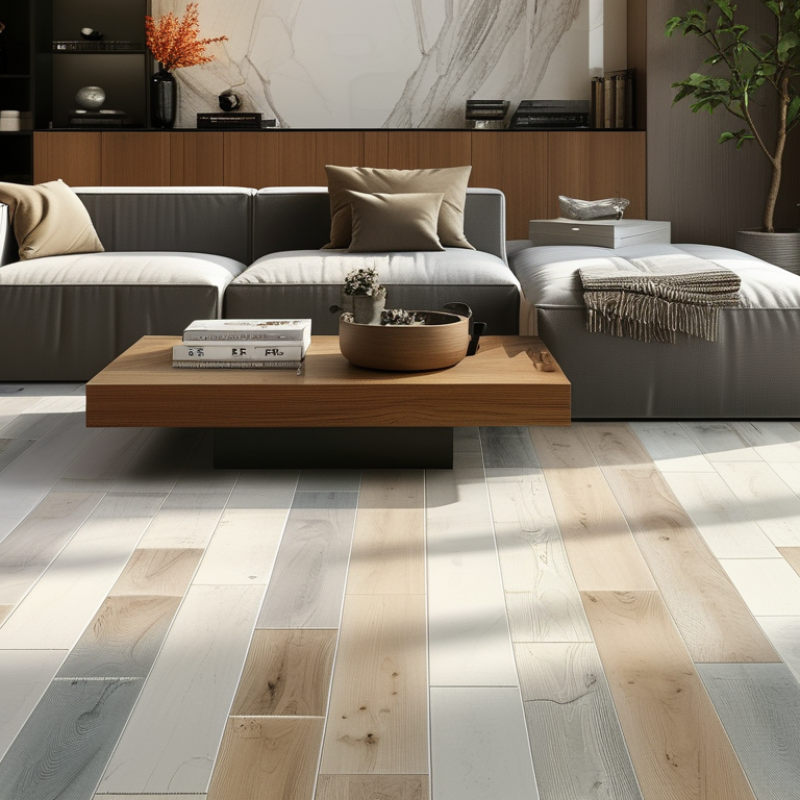
What Is Stone Plastic Flooring and How Does It Work?
Stone Plastic Flooring, often called SPC flooring, is a rigid floor made from limestone powder, PVC resin, and stabilizers. These materials form a dense core that resists dents and everyday moisture. It is not natural stone. Its strength comes from engineered compression, not from a solid rock slab.
A typical plank has several working layers. The bottom layer helps reduce movement. The SPC core provides rigidity and water resistance. A printed film creates wood or stone patterns, while the wear layer protects the surface from scratches. Some products also include a factory-attached underlayment. The planks usually connect through click-lock edges, creating a floating floor above a prepared subfloor.
Installation quality still matters. The subfloor should be clean, dry, and reasonably level. Small bumps can create hollow sounds or stress the joints. Leave an expansion gap near walls, cabinets, and heating pipes. In a kitchen, wipe standing water quickly, even though the planks resist moisture. Water-resistant does not mean every joint is permanently sealed.
It feels stable.
During evaluation, check the core thickness, wear-layer rating, locking profile, and installation instructions. A thicker plank may feel more solid, but it cannot correct a poor subfloor. Some sales descriptions also overstate scratch resistance. Sand, grit, and sharp furniture legs can still mark the surface. Choosing well means matching construction details to room conditions, not trusting appearance alone.
How to Choose Stone Plastic Flooring in 2026? - What Is Stone Plastic Flooring and How Does It Work?
| Selection Dimension | Typical Data or Range | What It Means | Practical Buying Guidance |
|---|---|---|---|
| Flooring Type | Stone plastic composite (SPC), a rigid-core resilient floor | The core commonly combines mineral filler, usually calcium carbonate, with polymer resin and stabilizers. | Confirm that the product is clearly identified as SPC or stone plastic composite rather than flexible vinyl flooring. |
| Construction Layers | Protective finish, wear layer, printed décor film, rigid SPC core, and attached or separate underlayment | Each layer contributes to appearance, abrasion resistance, dimensional stability, sound control, or installation performance. | Request a cross-section specification sheet and verify whether underlayment is already attached. |
| Overall Thickness | Commonly about 4–8 mm, including the wear layer and core; some products are thinner or thicker | Thickness affects transition height, perceived solidity, acoustic performance, and tolerance for minor subfloor irregularities. | Measure door clearances and adjoining floor levels before choosing a thickness. |
| Wear Layer | Common residential choices include 0.20–0.30 mm; higher-use products may use 0.50 mm or more | The wear layer helps protect the décor from surface abrasion and everyday traffic. | Choose the wear layer according to traffic, pets, wheeled furniture, and cleaning frequency; do not judge durability by thickness alone. |
| Water Resistance | The rigid core is generally water-resistant and does not readily absorb liquid | Water resistance applies to the flooring material; seams, edges, subfloor, and room construction can still be vulnerable. | Use approved sealing details where required, wipe spills promptly, and avoid assuming that every installation is waterproof. |
| Dimensional Stability | Generally more dimensionally stable than flexible vinyl, but expansion and contraction still occur | Temperature, sunlight, room size, and installation conditions can affect plank movement. | Follow the specified perimeter expansion gap and acclimation requirements, especially in large or sunlit rooms. |
| Installation Method | Floating click installation is common; glue-down installation is available for selected products | A floating floor locks planks together without full-surface adhesive, while glue-down flooring bonds directly to the prepared subfloor. | Select the method based on room size, moisture conditions, acoustic needs, maintenance plans, and manufacturer instructions. |
| Subfloor Flatness | Many rigid-floor systems require approximately no more than 3/16 inch variation over 10 feet, but the product specification controls | A rigid core can reflect high spots or voids, causing movement, joint stress, or noise. | Inspect and level the subfloor before installation; do not use the flooring to hide major unevenness. |
| Underfloor Heating | Compatibility varies; many products permit hydronic or electric systems under controlled temperature limits | Excessive heat can affect joints, adhesives, and dimensional stability. | Check the flooring temperature limit, heating-system instructions, and required moisture or commissioning procedure. |
| Acoustic Performance | Depends on core density, plank thickness, underlayment, subfloor, and installation quality | SPC can sound harder or more hollow underfoot than softer resilient flooring when installed without suitable acoustic treatment. | Review tested impact-sound or sound-transmission ratings where apartment or multi-level performance matters. |
| Slip Resistance | Performance is product-specific and should be supported by a recognized slip-resistance test | Surface texture, finish, contamination, and footwear influence slip behavior. | For bathrooms, entrances, or commercial areas, request documented wet and dry slip-resistance results. |
| Maintenance | Regular sweeping or vacuuming and damp mopping with a neutral cleaner are commonly recommended | Removing grit helps reduce scratching and premature wear. | Use soft cleaning tools, avoid abrasive powders and excessive water, and follow the product care instructions. |
| Indoor Air Quality | Look for tested low-emission performance and compliance with applicable flooring safety standards | Emissions can come from the flooring, backing, adhesive, or underlayment—not only the rigid core. | Request current laboratory documentation covering the complete flooring system where indoor air quality is important. |
| Fire Performance | Classification depends on the complete product and applicable local testing system | Fire behavior can change with backing, adhesive, underlayment, and installation assembly. | For public or commercial projects, verify the required fire classification from official test reports. |
| Best-Fit Applications | Living areas, bedrooms, hallways, offices, retail spaces, and many moisture-prone rooms when approved | SPC is valued for rigid feel, decorative variety, relatively simple installation, and resistance to everyday moisture. | Avoid locations exposed to standing water, uncontrolled outdoor conditions, or temperatures outside the product’s approved range. |
| Key Documents to Check | Technical data sheet, installation guide, care guide, warranty terms, test reports, and safety documentation | These documents reveal installation limits and performance claims that may not appear in product images. | Compare documented test results, installation requirements, and warranty exclusions before making a final decision. |
Footer
Affiliations