An x ray protection apron is designed to reduce exposure to scattered radiation during certain imaging procedures. It is commonly worn by staff who must remain near an X-ray source, and may be used for patients or companions when clinically appropriate. The apron’s protective material absorbs some radiation reaching the covered areas. It does not make exposure risk-free.
The scale of medical imaging helps explain why radiation protection matters. NCRP Report No. 160 estimated that average annual effective dose from medical procedures in the United States rose from about 0.5 mSv in 1980 to about 3.0 mSv in 2006. This figure describes population exposure, not the dose prevented by aprons. That distinction matters. An apron is one part of a broader protection plan, alongside distance, exposure time, equipment settings, and careful positioning. It should not be placed in the primary beam unless a qualified professional specifically directs it.
In practice, an apron should fit properly, cover the intended area, and be checked for damage under workplace procedures. A cracked or poorly stored apron may offer less reliable protection. Not a cure-all. Shielding recommendations can vary with the examination and current clinical guidance, so staff should follow their facility’s protocol rather than assume every patient needs an apron. Even good protection has limits. That point deserves attention.
What Is an X-Ray Protection Apron Used For?
What an X-Ray Protection Apron Is and How Pb Equivalence Is Rated
An X-ray protection apron reduces exposure to scattered radiation reaching the wearer’s torso during imaging procedures. It is commonly used by staff who remain near the patient, and sometimes by patients when clinically appropriate. The apron does not replace room shielding, distance, or careful positioning. Small details matter: an apron must cover the relevant area and fit without gaps.
Its label gives a lead-equivalence rating, written in millimetres of lead (mm Pb). This describes how much the material attenuates X-rays compared with a lead reference under specified test conditions; it does not state the apron’s actual lead content. Common ratings include 0.25, 0.35, and 0.50 mm Pb. IEC 61331-1:2014 describes test methods for protective-device attenuation, while IEC 61331-3:2014 addresses protective clothing. The measured performance depends on beam quality, so a rating is not a universal promise for every X-ray setting. A thicker rating may offer greater attenuation, but also adds weight. Comfort counts, too. Inspect the garment for damage and follow the facility’s quality-control procedure; a visual check alone can miss internal cracks. The label helps, but it is not the whole story.
Aprons help reduce occupational exposure to scattered X-rays. Their protection is commonly described by lead equivalence (mm Pb), rated under specified X-ray beam conditions.
How to read this chart: These are common nominal lead-equivalence rating classes, not measured percentages of radiation blocked. Actual protection depends on the product’s tested rating and the X-ray beam conditions. Follow local radiation-safety guidance.
An X-ray protection apron is designed mainly to reduce scattered radiation reaching parts of the body outside the area being imaged. During an X-ray, some radiation changes direction after interacting with the patient or nearby surfaces. Apron material can absorb much of this scatter. It does not make exposure disappear. That distinction matters.
Aprons are commonly relevant in fluoroscopy, where X-rays may be used repeatedly to guide a procedure. Staff standing near the patient can receive scattered radiation, especially around the torso and pelvis. A well-fitted apron helps reduce that exposure, while distance, protective screens, and careful positioning add further protection. Aprons may also be used in some dental or portable X-ray settings when a person must remain in the room. The exact need depends on the situation.
For patients, apron use is not automatically helpful during every diagnostic exam. Current guidance may discourage routine shielding when it could cover anatomy, interfere with exposure controls, or prompt a repeat image. This can feel counterintuitive. A clinician or radiographer can explain the local protocol and whether shielding is appropriate. Aprons also need proper storage and regular checks; cracked or poorly fitting material may offer less protection than expected.
An X-ray protection apron helps reduce exposure to scattered radiation during imaging procedures. Its lead-equivalence rating describes how well the material attenuates radiation compared with a specified thickness of lead under test conditions. It does not mean the apron contains that exact thickness of lead. Aprons are not a substitute for distance, shielding, or safe working practices.
A 0.25 mm Pb-equivalent apron is lighter and offers less attenuation than higher-rated options. It may suit settings where scatter exposure is lower, depending on the procedure and local guidance. A 0.35 mm rating offers a middle ground between weight and attenuation. A 0.5 mm rating attenuates more, but usually feels heavier. Small differences matter over a long shift. Fit matters.
The right choice depends on the procedure, radiation levels, apron coverage, and workplace protocols. Higher equivalence does not automatically make an apron the best choice for every person or task. Poor fit can leave gaps, while excess weight may discourage regular wear. That trade-off is not perfectly neat. Check the garment for cracks or damage as directed by your facility, and ask a radiation-safety professional when its condition or suitability is uncertain.
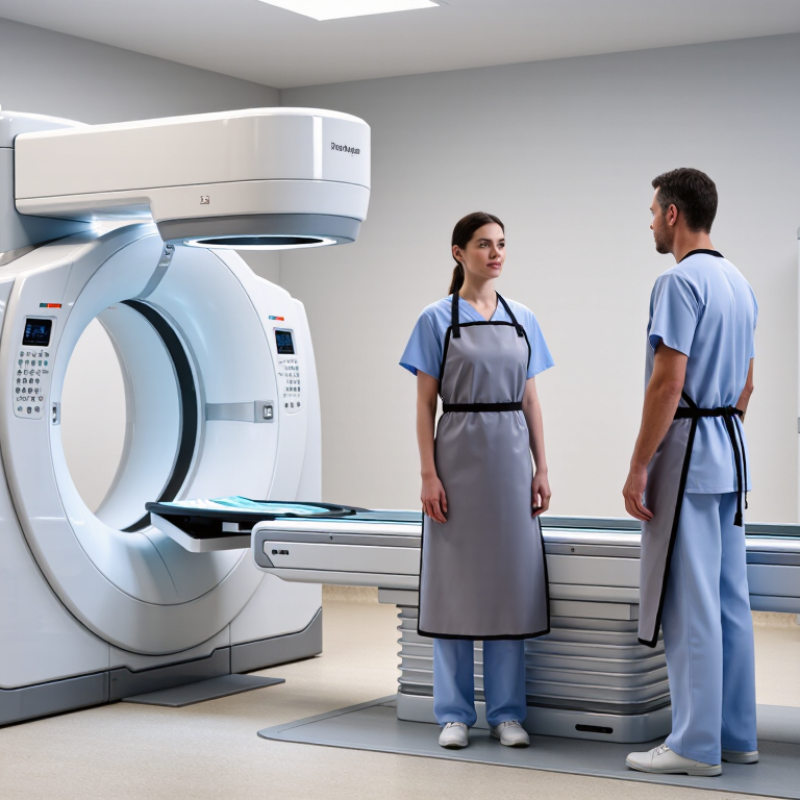
In radiography and fluoroscopy, protective aprons are mainly worn by staff who may receive scattered X-ray radiation during a procedure. This includes radiographers, radiologic technologists, radiologists, and physicians performing image-guided work. Nurses and other team members may also wear one when they need to remain near the patient or equipment. The apron does not make exposure disappear; it reduces exposure to covered areas of the body.
Who needs one depends on the task and where each person stands. A technologist positioning a patient may step behind a protective screen, while a clinician guiding a procedure may stay close to the imaging table. Staff working in the room often use an apron, sometimes with a thyroid collar, according to workplace procedures and individual risk assessment. Fit matters. So does training. A poorly fitting or damaged apron can be uncomfortable and may offer unreliable protection, so staff should check it as instructed and report defects. Not every person in the room automatically needs the same garment; distance, shielding, procedure length, and local safety guidance all matter. Even experienced teams can overlook small details, such as an apron left folded or a fastener not secured.
What Is an X Ray Protection Apron Used For?
How IEC 61331-3 Testing and Routine Inspection Support Safe Use
An X-ray protection apron reduces exposure to scattered radiation during diagnostic imaging. Its protection depends on the material, fit, and condition—not appearance alone. IEC 61331-3:2014 describes testing for protective clothing, including assessment of attenuation and declared lead-equivalent performance. Common ratings include 0.25, 0.35, and 0.5 mm Pb equivalent; the test beam quality matters when interpreting those figures. A rating is not a promise of identical protection in every imaging setting.
Testing supports purchase and acceptance decisions, but it cannot reveal damage that develops later. Follow the facility’s inspection schedule and applicable guidance, including IAEA radiation-protection recommendations. Check seams, closures, and the full surface regularly for cracks, thinning, or separation. If damage is suspected, take the apron out of service until it has been assessed. A small tear can be hard to spot.
Tips: Hang aprons on broad supports; do not fold them over a chair. Record inspection dates and findings. Use the same inspection method each time, and keep images or notes for comparison. Routine checks can feel repetitive, but that is exactly when missed details may creep in. Do not assume a clean exterior means the internal shielding is intact.
| Topic | Purpose or practice | What to check or understand | Safe-use action |
|---|---|---|---|
| Purpose of an apron | Provides attenuation of diagnostic X-rays to covered parts of the wearer’s body during relevant procedures. | Protection depends on the apron’s design, coverage, condition, beam quality, and the way it is used. | Use only where indicated by the facility’s radiation-protection procedures; an apron does not replace exposure controls or safe positioning. |
| Common applications | May be used by staff or patients when required for procedures involving diagnostic X-rays, including fluoroscopy and radiography. | Whether an apron is appropriate depends on the procedure, local rules, and the facility’s risk assessment. | Follow local protocols, especially for patient shielding, which may differ by procedure and jurisdiction. |
| Nominal lead equivalence | Aprons may be marked with a nominal lead-equivalent thickness, such as 0.25, 0.35, or 0.5 mm Pb. | These are examples of commonly encountered ratings, not a universal recommendation or a guarantee of protection in every situation. | Check the product label and choose equipment according to the procedure, applicable requirements, and facility guidance. |
| IEC 61331-3 testing | IEC 61331-3 addresses protective clothing, eyewear, and patient protective shields for diagnostic medical X-radiation. | Testing evaluates relevant protective characteristics, including attenuation or lead-equivalent performance, under specified test conditions. | Consult the applicable edition of the standard, product documentation, and procurement requirements when verifying conformity. |
| Visual check before use | A quick check can identify visible damage or problems with fit and fastenings. | Look for tears, cracked or brittle covering, loose seams, damaged closures, exposed protective material, or areas that no longer lie flat. | Do not use an apron with suspected damage until it has been assessed under the facility’s inspection procedure. |
| Periodic inspection | A documented inspection helps detect damage that may not be obvious during a brief visual check. | Inspection frequency should reflect the manufacturer’s instructions, use, storage conditions, and local requirements; there is no single interval suitable for every facility. | Record the inspection date, item identification, findings, and any repair, removal, or follow-up action. |
| Imaging-based inspection | Radiographic or other suitable imaging inspection can help assess internal defects in the protective material. | Review the full apron, including folds and seams, using a controlled method and the facility’s acceptance criteria. | Have results interpreted by trained personnel; remove an item from service if defects exceed the applicable criteria. |
| Storage and handling | Correct handling helps reduce avoidable damage to the protective material. | Repeated folding, crushing, or hanging from unsuitable supports can stress the apron and contribute to damage. | Store flat or on a suitable apron hanger, following the manufacturer’s care instructions. |
| After damage is suspected | Prompt assessment helps prevent continued use of equipment that may not provide its intended protection. | Visible defects, abnormal imaging findings, or uncertain condition require review against the relevant criteria. | Identify and quarantine the apron as needed; repair, return, or dispose of it according to manufacturer guidance and facility policy. |
| Important qualification | Testing and inspection support safe use but do not guarantee protection in every exposure scenario. | Acceptance limits, test methods, and inspection intervals can depend on the applicable standard, regulations, manufacturer, and facility policy. | Use current local requirements and product documentation rather than treating this table as a substitute for them. |
1901 West Main Street
Washington, MO 63090
Main Directory: 1-800-227-4873
Email: sale@pangcofurniture.com

We’re always looking for talented individuals to join our team. Send us your resume using the form below. When a position comes available that matches your skillset, one of our team members will reach out to you.
"*" indicates required fields